
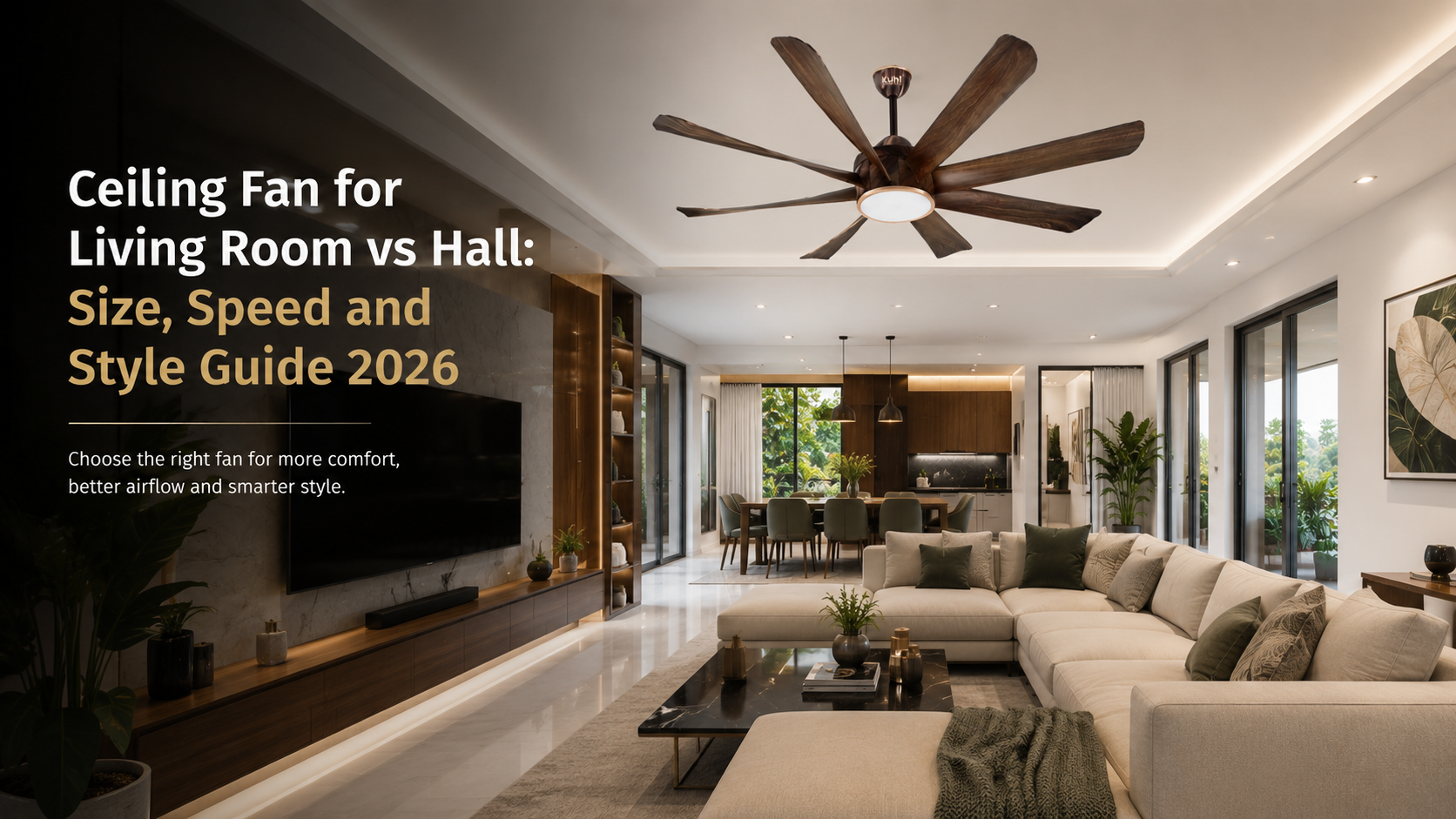
The living room usually sees more foot traffic, more furniture, and more design scrutiny than any other space in the house. Choosing a fan for it isn't quite the same exercise as picking one for a bedroom: size, style, and even light integration all carry more weight here.
This guide walks through what actually matters when selecting a living room or hall ceiling fan in 2026.
Which Ceiling Fan Is Best for a Large Living Room or Hall?
Large living rooms and halls need a fan that can move air evenly across an open floor plan, often with higher ceilings and less furniture blocking airflow. A hall ceiling fan built on a strong BLDC motor tends to outperform standard induction models here, delivering consistent air movement without the higher running cost of older motor types.
Why Does Motor Choice Matter More in Bigger Spaces?
Motor inefficiency is not so apparent in small rooms. But in a big hall, the weaker motor has to work harder to circulate air throughout the whole space. This shows up in both comfort and on the electricity bill. You must pick the right motor, especially in bigger spaces.
What Size Ceiling Fan Suits a Hall in 2026?
Sizing still follows basic square footage logic, though open-plan halls in newer homes are trending larger, which has pushed demand toward bigger sweep sizes.
Quick Sizing Reference
For most modern halls, this configuration makes a living room ceiling fan in the 1400mm range a practical starting point, adjusted for actual room dimensions.
Should a Living Room Fan Have Lights or a Plain Design?
This depends on the room's existing lighting plan rather than a fixed rule. If the living room already has adequate ambient lighting, a plain, sculptural fan often works better as a design statement. If the room needs additional light, say, in an open hall with high ceilings, a fan with integrated LED lighting can serve two purposes without adding another fixture.
Where Does a Decorative Fan Add Value?
A decorative ceiling fan with clean lines and a low-profile motor housing tends to blend into premium interiors more naturally than a bulkier, traditional design, which is part of why this segment has grown steadily among urban homeowners.
Which Ceiling Fan Style Trends Will Be Popular for Halls in 2026?
Minimal silhouettes, matte finishes, and understated metallics continue to dominate premium interiors this year, moving away from ornate, traditional fan designs. A modern ceiling fan design with a slim motor body and tapered blades tends to suit open, high-ceiling halls better than boxier, older-style fans.
Kühl's Approach to Hall-Ready Design
Our Luxus and Centauri series reflect this shift, pairing BLDC motor efficiency with slim profiles and optional integrated lighting, along with smart controls for larger, multi-fan setups. These models are a practical fit for the best fan for large room requirements in contemporary halls.
Create a More Comfortable Living Space with the Right Ceiling Fan
A living room or hall ceiling fan earns its place through a combination of size, motor efficiency, and design that suits the space, not through any single factor alone. Getting these right upfront saves both comfort and cost over the years ahead.
Planning to renovate your living room/halls this year? Check out the Kühl BLDC fan range, where size, style, and smart engineering come together thoughtfully.
FAQs
-
What size ceiling fan is best for a living room?
Ans: It depends on the square footage of the room, but most living rooms up to around 150 ft. do well with a 1200mm to 1400mm fan. -
What’s the best type of ceiling fan for a hall?
Ans: Minimal, low-profile designs generally suit halls best, particularly in homes with a modern interior theme. -
Should I choose a fan with an LED light for the living room?
Ans: Only if the room needs additional lighting. If ambient lighting is already sufficient, a plain design usually works better visually. -
How many ceiling fans are needed for a large hall?
Ans: Halls beyond roughly 250 sq. ft. typically need two or more fans to maintain even airflow across the space. -
What speed setting is ideal for hall ceiling fans?
Ans: A mid-to-high setting usually works well for larger halls, though smart fans allow this to be adjusted easily based on occupancy and season.


