
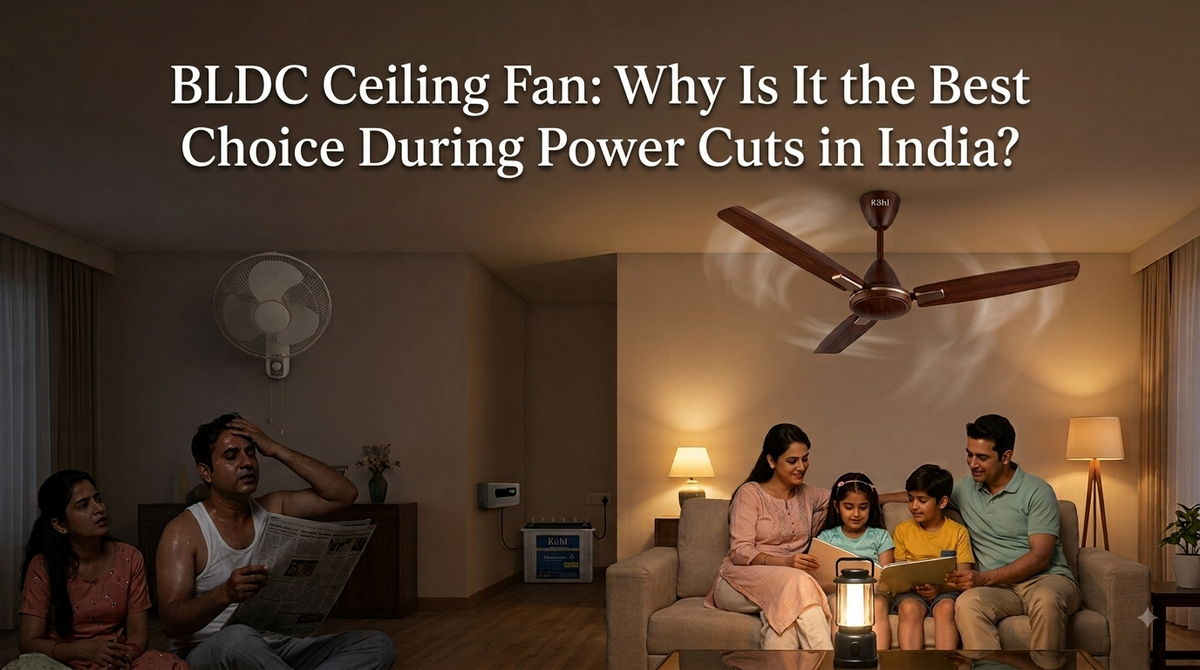
Power cuts don't announce themselves. One moment, the fan is running; the next, you're left wondering how long the backup power will last.
For most Indian households, especially in the summer, this question comes up more often than anyone would like. The answer, as it turns out, has a lot to do with the power-saving fan itself, not just the inverter.
Which Ceiling Fan Runs the Longest on an Inverter During Power Cuts?
The fan that runs longest is simply the one drawing the least power. A regular induction fan pulls around 75-80 watts at full speed, which eats into inverter battery reserves fairly quickly. A BLDC fan built on more efficient motor technology draws 25-30W, which means the same battery runs for much longer.
Why Is Wattage the Real Deciding Factor?
It's tempting to judge a fan by its airflow or design, but during a power cut, wattage is what actually determines how many hours you get. A low-power-consumption fan doesn't just save on your electricity bill during normal use; it also becomes the difference between comfort and an uncomfortably short backup window.
Is a BLDC Fan Better for Inverter Backup Than a Normal Fan?
Yes, and the gap isn't small. A typical induction fan runs at roughly 75-80 watts, while a BLDC fan can operate at full speed using around 29 watts. That's close to a third of the power for the same airflow. On an inverter, this difference compounds quickly.
Kühl's Prima series, for instance, runs on a 29-watt BLDC motor and is designed to run up to three times longer on an inverter battery compared to standard induction fans, simply because the motor is doing more with less power.
What Does This Difference Mean in a Real Power Cut?
Picture a two-hour outage on a regular evening. A home running an induction fan might see the inverter struggling by the end of it, especially if other appliances are also drawing power. The same inverter, powering BLDC fans instead, has considerably less power to draw.
How Many Hours Can an Inverter Run a Ceiling Fan?
The answer depends on the inverter's battery capacity and how many fans (or other devices) are running off it at once. As a rough guide, a fan drawing under 30 watts will run notably longer than one drawing 75-80 watts on the same battery. This is really where a BLDC fan for inverter use earns its place, since the everyday efficiency it offers becomes critical the moment the grid goes down.
What Wattage Ceiling Fan Is Best for Inverter Usage?
Anything in the 28- to 35-watt range is a strong choice for inverter reliance. Our BLDC fans running at just 29 watts sit comfortably in this bracket, offering high airflow without placing heavy demand on backup power. For households in areas with frequent outages, a power-saving fan in this wattage range isn't a luxury; it's practical planning.
Choose a Fan That Works Even When the Power Doesn't
A power cut is rarely convenient, but the right fan can make it far more bearable. Choosing a fan for power cuts based on wattage, not just design, is one of those small decisions that pays off precisely when it matters most.
If you're planning ahead of the next outage-prone season, it's worth exploring our BLDC ceiling fan range to see how thoughtful engineering keeps your home comfortable.
FAQs
-
What is a BLDC ceiling fan?
Ans. It's not a separate fan category exactly; it refers to a fan efficient enough to run comfortably on inverter power, typically drawing well under standard induction wattage.
-
Can a normal ceiling fan run on an inverter?
Ans. Yes, but it will drain the battery faster due to higher power draw, giving you fewer hours of backup compared to a BLDC fan.
-
How much backup does a BLDC fan give on an inverter?
Ans. It varies by battery capacity, but BLDC fans like Kühl's can run up to three times longer than induction fans on the same inverter setup.
-
Which fan wattage is ideal for power cut situations?
Ans. Somewhere between 28 and 35 watts strikes a good balance between strong airflow and manageable power draw during outages.
-
Does a BLDC fan cost more than a regular ceiling fan?
Ans. Usually, yes, upfront. But the extended backup time and lower daily electricity use tend to offset that cost over time.


