
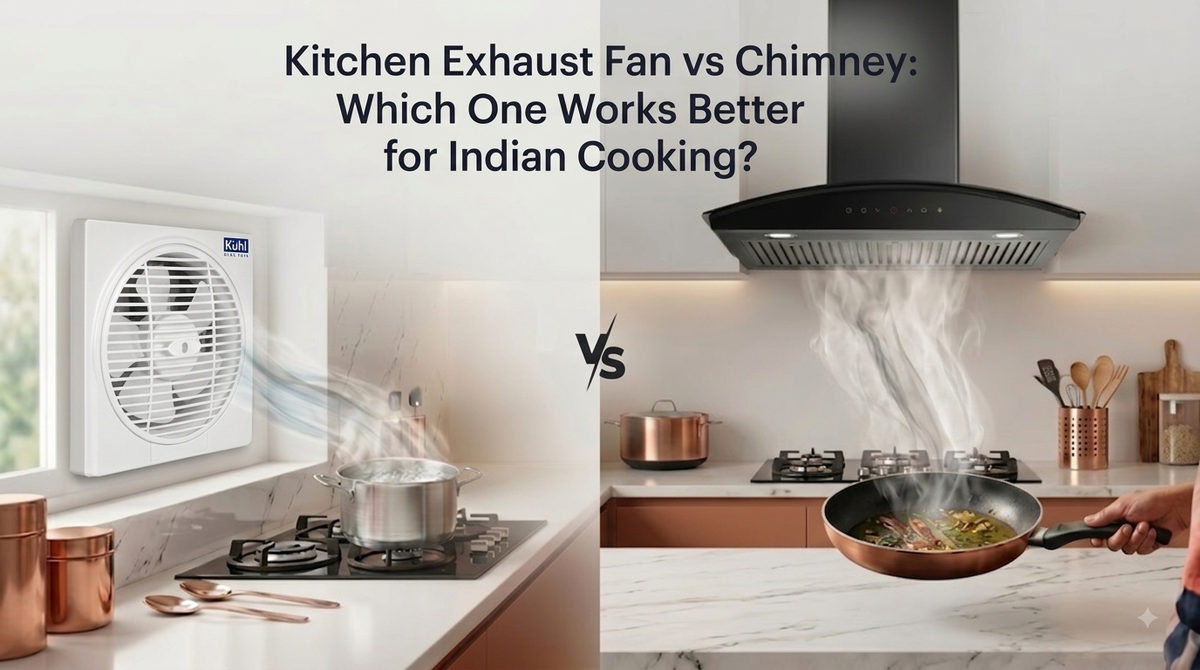
Indian cooking produces a particular kind of smoke and oil mist that most Western kitchen designs simply weren't built for. Tempering spices in hot oil, deep frying, or cooking on a high flame for long stretches all send grease and steam upward fast.
The chimney vs. exhaust fan question comes up constantly during kitchen renovations. However, the honest answer depends on how the kitchen is actually used. Let’s figure it out!
Is a Kitchen Exhaust Fan Better Than a Chimney for Indian Cooking?
Not universally, but often in specific situations. A kitchen exhaust fan works by pulling air out of the room through a wall or window opening, without any real filtration. A chimney, by contrast, sits directly above the cooktop and pulls smoke, oil vapour, and heat through filters before venting them out.
Where Each One Genuinely Excels
Exhaust fans do a solid job of clearing general room air, steam, and lighter cooking odours. Chimneys are built specifically to intercept oil-heavy smoke right at the source, before it spreads across the kitchen and settles on cabinets, walls, and ceilings.
Which Removes Smoke Faster: An Exhaust Fan or a Chimney?
For oil-heavy Indian cooking, a chimney typically clears smoke faster, simply because it's positioned directly over the flame and starts pulling smoke before it disperses. An exhaust fan, usually mounted on a wall some distance away, has to wait for smoke to travel across the room first.
Why Does Placement Make the Real Difference?
The difference is about where the extraction happens. A chimney intercepts smoke above its source; an exhaust fan clears it once it's already spread through the room.
Is an Exhaust Fan Cheaper Than a Chimney for a Kitchen?
Yes, generally by a noticeable margin. A basic kitchen exhaust fan is generally much cheaper to purchase and install than a chimney, which requires ducting, filters, and usually a professional to install. This cost difference is important for smaller budgets or rental kitchens.
What Does the Lower Price Trade Off?
Exhaust fans are for improved airflow through the removal of heat, moisture, smoke and odours, not for grease filtration or task lighting. They are a good ventilation solution for many kitchens, especially where a chimney is not possible due to space or installation limitations.
For households with intensive daily frying or heavy cooking, a kitchen chimney may provide better grease management.
Should I Install Both an Exhaust Fan and a Chimney in the Kitchen?
For larger kitchens, or ones used heavily throughout the day, running both isn't unusual. The chimney deals with the direct smoke (which is heavy on oil) at the hob. The exhaust fan deals with general kitchen ventilation; it clears any remaining smoke and keeps the air circulating when the chimney is not in use.
When Does This Combination Make Sense?
The biggest beneficiaries are open kitchens attached to living spaces or households that cook frequently throughout the day. It also decreases reliance on a single appliance and makes the kitchen more comfortable altogether.
Choosing the Best Kitchen Exhaust Fan for Your Home
No best kitchen exhaust fan or chimney suits every household. The right choice depends on how much oil-heavy cooking you do daily, the kitchen's layout, and your budget. A compact exhaust fan suits light, occasional cooking well, while a chimney earns its cost in kitchens where frequent, oil-based Indian meals are made.
For those leaning toward a kitchen exhaust fan, our Ventis series is worth a look. Built on BLDC technology, it comes in 6-inch and 8-inch sizes and is designed to clear stale air, moisture, and odours from both kitchens and bathrooms. It's a straightforward option for households that don't need the extraction power of a full chimney but still want something more capable than a basic wall fan.
Our approach to engineering and efficient BLDC motors built for daily use extends across our ceiling fan range as well. For homes planning a renovation, it's worth exploring Kühl's BLDC ceiling fans.
FAQs
-
What is the difference between a kitchen exhaust fan and a chimney?
Ans. An exhaust fan clears general room air through a wall vent, while a chimney sits above the cooktop and filters oil-heavy smoke directly at the source.
-
Which is more effective for Indian style cooking?
Ans. A chimney is usually more effective for heavy, oil-based Indian cooking, since it captures smoke before it spreads through the kitchen.
-
Is an exhaust fan enough for a small kitchen?
Ans. Yes, an exhaust fan can do a pretty good job of ventilation without a chimney, especially for light cooking and smaller kitchens.
-
Does a chimney need more maintenance than an exhaust fan?
Most of the time, yes. Exhaust fans need little maintenance. Chimney filters should be cleaned or replaced from time to time to ensure they are working properly.
-
Which is more budget-friendly, an exhaust fan or a chimney?
The exhaust fan is usually cheaper to start with and cheaper to install.


