
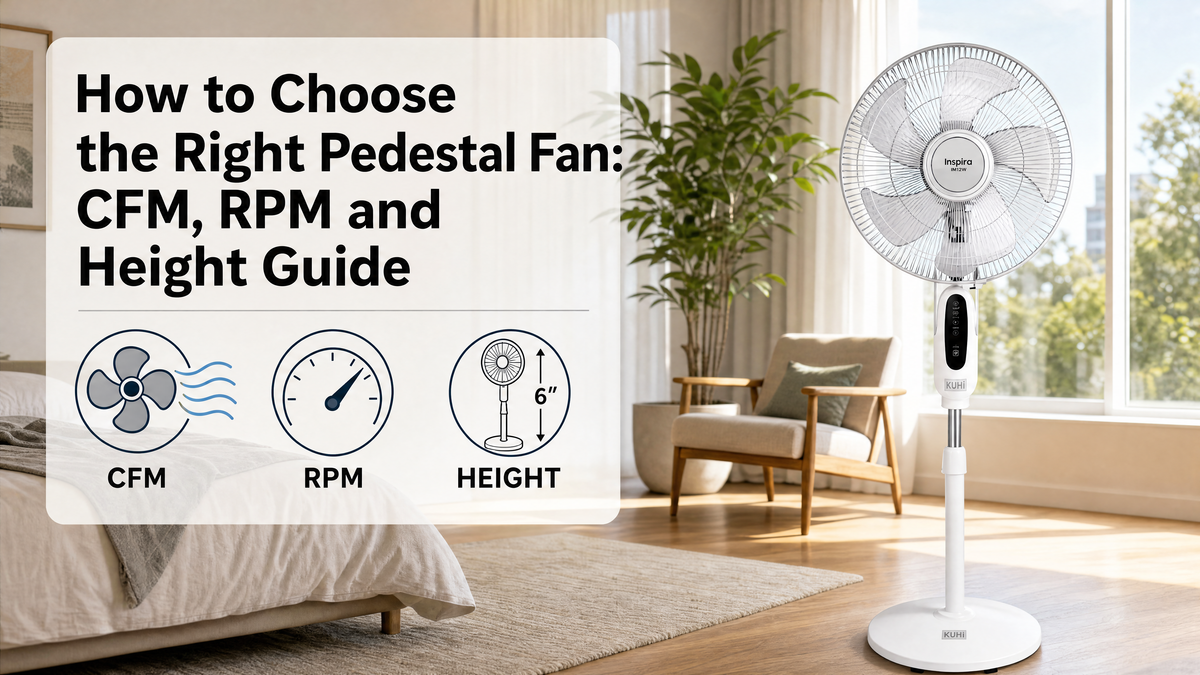
Choosing a pedestal fan starts with where you want the breeze. Its height, tilt, and speed settings determine how comfortably the air reaches your favourite spot.
The motor deserves equal attention if the fan runs for hours each day. BLDC technology can use less electricity than a comparable conventional motor, while the fan’s air-delivery figure tells you how much air it actually moves.
CFM, RPM, motor, and height: they sound technical, sure, but they really decide whether the fan cools the room or just spins there for show. Let's get into it.
How to Choose the Right CFM for a Pedestal Fan?
CFM stands for cubic feet per minute, and it tells you how much air the fan is actually pushing out. Honestly, it's the best single indicator of real-world cooling you'll find, better than blade size, and better than motor wattage. For a mid-sized room, a pedestal fan worth buying should sit somewhere in the 2000-2500 CFM range to feel genuinely effective.
Why Does CFM Matter More Than Most Buyers Realise?
Here's the thing: two fans can sit side by side looking almost identical and still cool a room completely differently once you switch them on.
Pedestal fan airflow depends on blade design and motor efficiency working together, not just one or the other. That's precisely why the CFM number tells you more than the size of the fan or its price tag ever could.
What RPM is Best for a Pedestal Fan?
RPM (Rotations per minute) is simply how fast the blades spin. People often think it's the main measure of airflow, but it's really just one part of the overall picture. On high speed, most home fans land somewhere between 300 and 380 RPM, which is a reasonable middle ground between strong airflow and not overworking the motor.
RPM Alone Doesn't Tell the Whole Story
A fan spinning faster doesn't automatically move more air, not if the blades themselves aren't shaped efficiently. This is actually where BLDC motors pull ahead. They can push consistent, high airflow without needing to spin unnecessarily fast, and as a bonus, they tend to run quieter too. Our Inspira pedestal fan range incorporates this technology.
What Height Should a Pedestal Fan Be for the Best Airflow?
Somewhere between 3 and 4.5 feet off the floor tends to work best for most rooms. This range roughly matches seated or standing eye level, and air simply travels further and more evenly from there.
Set a standing fan too low, and you end up cooling the floor more than the room. Set it too high, and the airflow just passes over everyone's heads.
Adjusting Height Based on Room Use
In a bedroom, dropping the fan a little closer to bed height usually feels more comfortable. In a living room or office, though, raising it a bit helps spread the air more evenly across a group of seated people, instead of blasting one lucky (or unlucky) person directly. And the tilt mechanism of our Inspira pedestal fan range can help you adjust height effortlessly!
Which Pedestal Fan Specs Matter Most Before Buying?
Beyond CFM, RPM, and height, consider the motor, noise level, and oscillation. A high speed pedestal fan may move plenty of air, but motor noise can become tiring when it runs for hours. Oscillation matters too: it helps share the breeze across a seating area instead of directing it at one spot.
Where Kühl Fits Into This Comparison
At Kühl, we bring the BLDC technology used in our ceiling fans to the Inspira pedestal fan range. The motor uses electronic control to operate efficiently, making power draw worth checking alongside airflow. The Kühl Inspira P1 draws 28 W of power, while the Kühl Inspira P2 draws 60 W of power and delivers more air.
Both models also offer low-noise operation, oscillation, remote control, and a digital speed display. You can adjust the speed or set the fan to swing without leaving your seat. These details are easy to appreciate beside a work desk, in a bedroom, or through a long evening in the living room.
Get Better Airflow with the Right Pedestal Fan
Choosing a pedestal fan well really just means looking past the price sticker and paying attention to the numbers that decide comfort: CFM for real airflow, RPM as a secondary check, and height matched sensibly to how the room gets used. Nail these, and the fan quietly does its job, day after day, without any drama.
Kühl’s BLDC-powered Inspira P1 offers a lower-power option for focused use, and the Inspira P2 delivers more air for a larger area.
For efficient engineering and advanced BLDC technology, check out Kühl's Inspira pedestal fan.
FAQs
-
What is CFM in pedestal fans?
Ans. CFM, short for cubic feet per minute, tells you how much air a fan actually pushes out — and it's the number that best reflects real cooling performance.
-
What RPM is ideal for a pedestal fan speed?
Ans. Somewhere around 300 to 380 RPM on high speed works well for most homes, giving decent airflow without overworking the motor.
-
What height is best for pedestal fan placement?
Ans. Between 3 and 4.5 feet off the floor is usually the best height, roughly matching typical seated or standing heights.
-
Does higher CFM mean more airflow in a pedestal fan?
Ans. It does, pretty directly. A higher CFM number simply means more air is moving, which you'll feel as stronger, more noticeable cooling. -
Which pedestal fan specs should I compare before buying?
Ans. Look at CFM, RPM, motor type, noise level, and oscillation range together, not just the size or the price tag on its own.


