
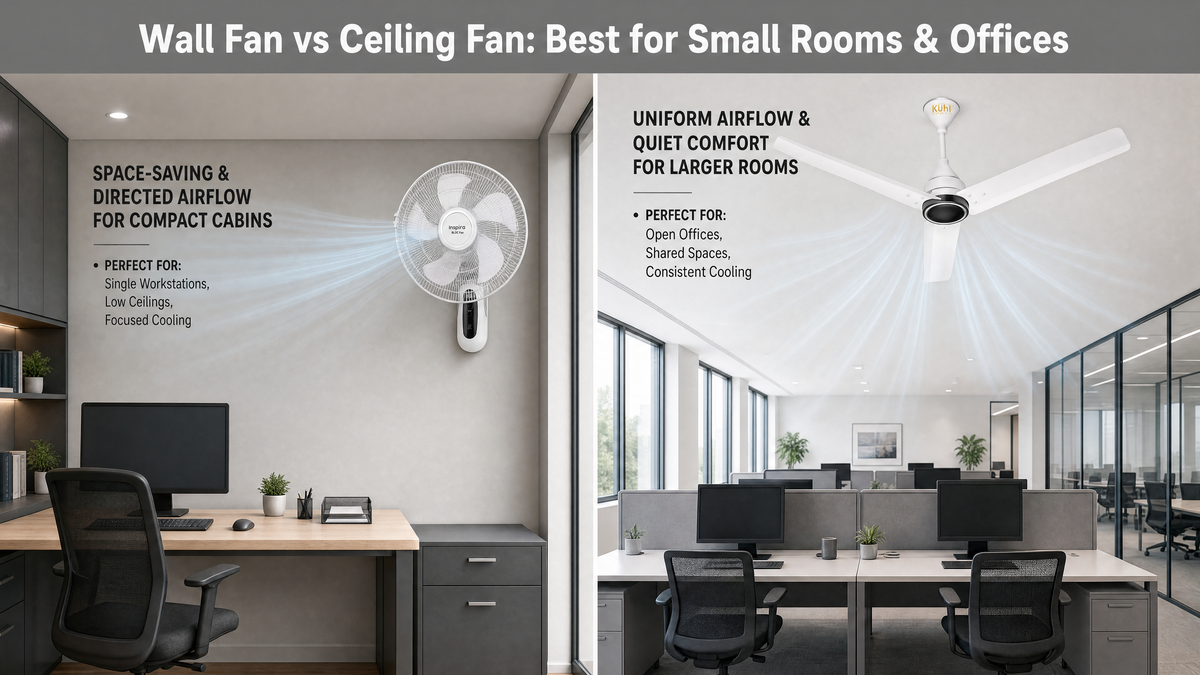
Small rooms and compact office cabins present the same problem: not enough ceiling height or floor space, or sometimes both. That's usually the moment the wall fan vs ceiling fan question comes up. There isn't a single answer that suits every space.
What you choose depends on the room layout, the ceiling height and how you use the space every day. Let’s take a look!
Is a Wall Fan Better Than a Ceiling Fan for Small Rooms?
Not really better, just built to solve a different problem. A wall fan mounts onto a wall, usually a few feet up, and pushes air in a fixed or oscillating direction across the room. A ceiling fan works differently altogether, pulling air down and circulating it across the whole room from above, which tends to feel more even in most day-to-day living spaces.
Where Each One Actually Wins
In a compact room with low ceilings, a wall fan helps maximise available ceiling space. But once a room grows beyond genuinely compact, a ceiling fan usually cools more consistently, simply because it isn't stuck pushing air in just one direction.
Kühl's BLDC ceiling fans combine precision-balanced blades with efficient motors to deliver uniform airflow while maintaining quiet operation and lower energy consumption. The range is ideal for bedrooms, living rooms and small offices that require all-day comfort.
Which Fan Type Suits Offices Better: Wall or Ceiling?
Depends entirely on the kind of office we're talking about. A small individual cabin or a workstation tucked near a wall often works perfectly well with a wall fan, especially in buildings where the false ceiling height or existing wiring rules out a ceiling fan. Larger, open-plan offices require a different approach. They generally need ceiling fans to keep air moving evenly across a bigger shared floor.
Wall Fan vs. Ceiling Fan: A Quick Comparison
|
Factor |
Wall Fan |
Ceiling Fan |
|
Best suited for |
Compact cabins, low ceilings |
Larger rooms, open offices |
|
Airflow coverage |
Directional |
Whole-room |
|
Installation Requirements |
Wall-mounted |
Ceiling-mounted |
|
Space required |
Minimal wall space |
Requires adequate ceiling height |
If you are providing different types of workspaces, then we have both wall fans and energy-efficient BLDC ceiling fans. Instead of a one-size-fits-all approach, you can select the right solution for room size, ceiling height and airflow requirements.
Does a Wall Fan Save More Space Than a Ceiling Fan?
Yes, a wall fan takes up less floor and ceiling space. Since it sits flush against a wall instead of hanging from the ceiling, it fits neatly into rooms where ceiling height is tight or where a pendant light or AC duct has already claimed that space.
This is exactly why an office wall fan gets picked so often; it slots into a tight cabin without needing an inch of ceiling clearance.
Where Does the Space Saving Actually Matter?
You'll notice this benefit most in older buildings or converted spaces with lower-than-standard ceilings, places where a ceiling fan simply wouldn't have the clearance to run safely, let alone efficiently.
The Kühl Inspira W1 wall fan features oscillating airflow to improve air circulation across compact rooms while making efficient use of wall space.
Which Fan Gives Better Airflow in Small Office Cabins?
For a genuinely small cabin, a compact cooling fan on the wall provides effective airflow, since it's only working a focused zone rather than an entire open area. Step up to a slightly bigger cabin or a shared space, though, and a well-engineered ceiling fan becomes the better choice, spreading air more evenly across every desk instead of concentrating it in one direction.
What Does This Mean Practically?
If it's one or two people sitting close to a wall, go with a wall fan; it's a practical choice. If it's a shared space with desks spread across the room, a ceiling fan is going to serve everyone better.
Our BLDC ceiling fan range is engineered to provide quiet operation, energy efficiency, and consistent airflow across larger rooms and office spaces.
Pick the Fan That Fits Your Home or Office
There's no clear choice between a wall fan and a ceiling fan. It depends on room size, ceiling height, and how the space is used day to day. Compact cabins and low-ceiling rooms tend to suit a small room fan mounted on the wall, while larger rooms and open offices are usually better off with a ceiling fan's even, whole-room airflow.
For spaces where a ceiling fan makes more sense. Explore Kühl's wall fan and BLDC ceiling fan range to find a solution that matches your space, airflow requirements, and everyday comfort needs.
FAQs
-
What is the difference between a wall fan and a ceiling fan?
Ans. A wall fan mounts on a wall and pushes air in a fixed or oscillating path, while a ceiling fan circulates air across the whole room from above.
-
Which fan is better for small rooms?
Ans. For genuinely compact rooms or low ceilings, a wall fan often works better. As the room gets larger, a ceiling fan is usually the better choice.
-
Is a wall fan suitable for office use?
Ans. Yes, especially for small cabins or single workstations where ceiling height is tight or a ceiling fan just isn't practical to install.
-
Does a wall fan need less installation space?
Ans. It does. A wall fan only needs a bit of wall space and skips the ceiling clearance a ceiling fan requires.
-
Which fan is quieter, a wall fan or a ceiling fan?
Ans. Noise levels depend more on motor quality and blade design than on whether the fan is wall-mounted or ceiling-mounted. Kühl BLDC-powered fans generally operate more quietly than conventional induction models.


