
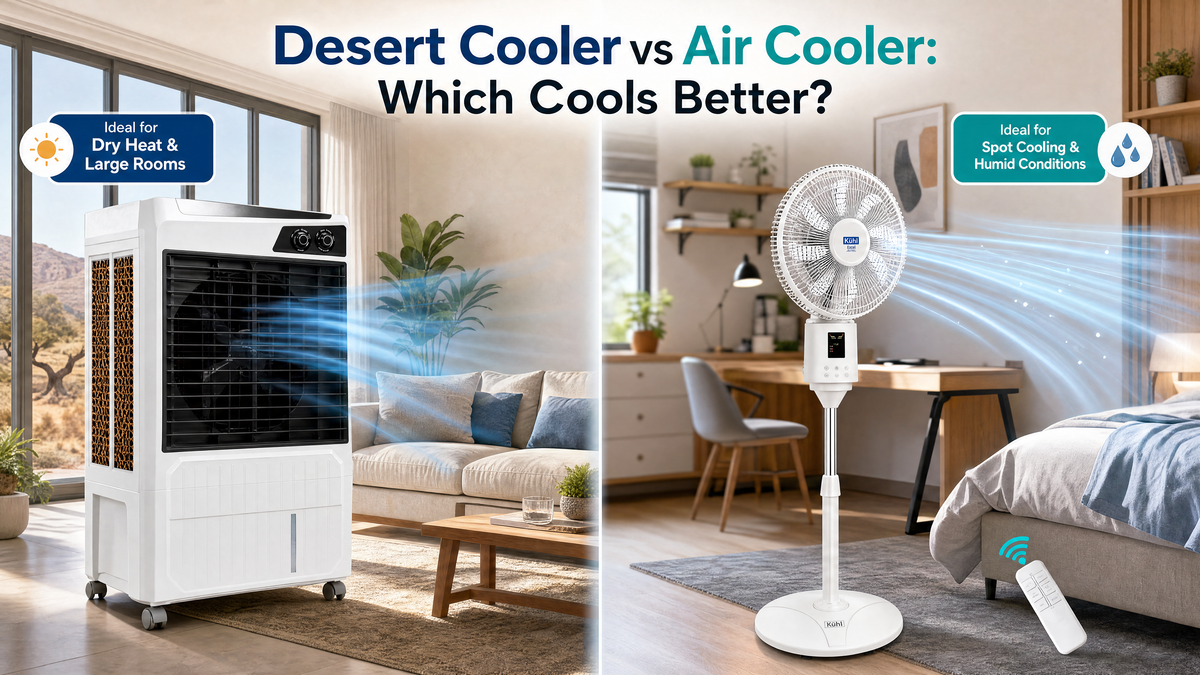
Summer shopping in India almost always brings up the same dilemma at some point: desert cooler or air cooler? The names get used interchangeably in conversation, but the two aren't quite the same thing. Choosing the wrong one for your climate can leave you with a machine that barely cools the air.
How to pick the right one for a specific Indian weather climate? Well, this is the guide for you!
Which Cooler Works Better in Dry Heat: Desert Cooler or Air Cooler?
In genuinely dry heat, a desert cooler tends to perform better. It has bigger tanks, larger pads and more powerful motors, so it is built to cope with long periods of intense heat, evaporating water more aggressively. It works especially well when the surrounding air itself is dry.
Why Do Dry Climates Suit This Design?
Dry air is needed to absorb moisture through evaporative cooling. In Rajasthan, Punjab or much of North India during peak summer, low humidity allows a desert cooler to evaporate water quickly and, hence, suck heat from the air effectively. Choosing a desert cooler works perfectly fine for this type of weather!
Is a Desert Cooler Suitable for Humid Indian Weather?
Not particularly. In humid regions, the air is already carrying a lot of moisture, so a desert cooler's core mechanism, evaporating more water into the air, has far less room to work. The result is a room that feels damp rather than genuinely cool.
What Happens in Coastal or Monsoon-Prone Areas?
A cooler for humid climate conditions, like coastal Maharashtra, Kerala, or parts of West Bengal, generally performs poorly compared to a desert cooler. A compact air cooler, used more for quick, localised cooling, tends to be the more sensible option here, even though its overall cooling capacity is smaller.
Which Cooler Type Cools Faster in North Indian Summers?
For the dry, high-temperature summers typical of North India, a desert cooler usually cools a room faster, simply because it's built for larger spaces and higher airflow volumes. Its bigger tank also means fewer interruptions for refilling during long, hot afternoons.
Kühl Brizo DC 100 offers a powerful and reliable cooling experience. It has a dedicated ice chamber and high-efficiency honeycomb cooling pads with 100L tank. The strong air delivery system ensures wide and even airflow in your room.
A Practical Trade-Off You Must Keep in Mind
That speed and capacity have a size. Desert coolers are much bulkier and heavier. Thus, they are less practical for smaller rooms or apartments with limited floor space.
What Is the Difference Between a Desert Cooler and a Personal Air Cooler?
The only real difference is the scale and airflow, not the underlying tech. The three most important factors when comparing desert cooler vs air cooler will be:
- Tank size
- Strength of blower
- Area of coverage
Personal air coolers are used for single rooms or smaller spaces, whereas desert coolers are used for large rooms or open halls. It is not only about the cooling power but also about the portability.
Choosing Based on Room Size, Not Just Climate
Even in a dry region, a small bedroom doesn't necessarily need a full desert cooler. A compact air cooler can do the job just as well at that scale, without the bulk or higher water consumption.
Stay Cool with the Right Air Cooler
The best cooler for summer depends largely on two factors: the dryness or humidity of your area and the size of the space to be cooled. Desert coolers suit big, dry, open areas, whereas air coolers fit smaller rooms or more humid climates better.
We don’t just make fans. We make desert and personal air coolers too, all with the same principle of efficient, dependable engineering to make your home comfortable. Check out our range of energy-efficient coolers and make the right choice!
FAQs
-
What is a desert cooler?
Ans. Think of it as the bigger sibling in the cooler family. It comes with a larger water tank and a stronger blower, meant for cooling sizeable rooms or halls through long, dry summer days.
-
Does a desert cooler work well in humid weather?
Ans. Not really, and there's a simple reason why. Humid air is already holding a lot of moisture, so the cooler can't evaporate water into it efficiently. You end up with a room that feels sticky rather than cool.
-
Which cooler is best for North Indian summers?
Ans. For most North Indian homes, a desert cooler is the better fit. The dry heat plays to its strengths, and it's built to handle the larger rooms common in that region.
-
Is a desert cooler bigger than a regular air cooler?
Ans. It is noticeably so. Between the tank size and the overall body, desert coolers take up more space, while air coolers are built to stay compact for smaller rooms. -
Which cooler type needs more water refills?
Ans. Here's the surprising part: it's usually the personal air cooler. Its tank is smaller to begin with, so despite running for similar stretches, it empties and needs topping up sooner.


