
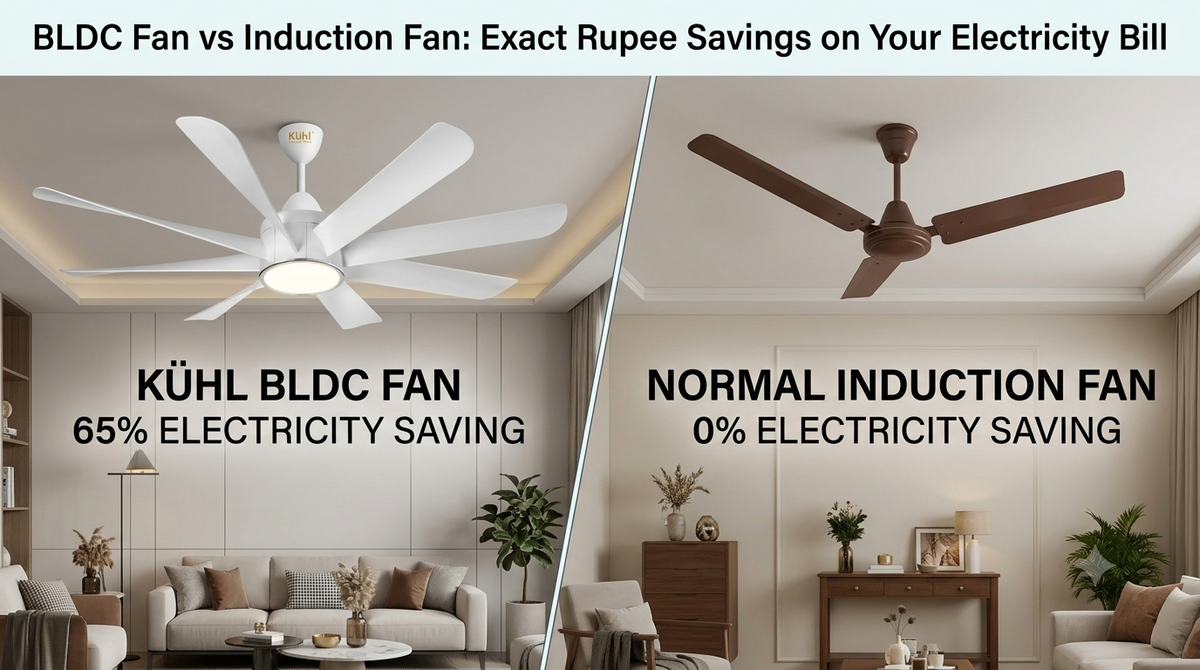
Every summer, as fan speeds climb, so does the electricity bill, and most homeowners never ask why. The answer often lies in the motor. Traditional induction fans and modern BLDC fan technology consume power very differently. This difference shows up in rupees, not just kilowatts.
Which fan technology is more energy efficient, BLDC or induction? This guide breaks down exactly how much you could save by switching, using real wattage figures and everyday usage patterns.
Why Do Induction Fans Cost More to Run?
Most ceiling fans installed over the last few decades use induction motors. They continuously draw alternating current to create a rotating magnetic field. A typical induction fan consumes around 75–80 watts at full speed. This process necessarily results in energy loss, as some of the electricity used is lost as heat and not converted to airflow.
Is a BLDC Fan Really Worth Buying Over a Normal Induction Ceiling Fan?
A BLDC ceiling fan has a Brushless Direct Current motor that is electronically commutated rather than mechanically switched. This design removes much of the friction and heat loss associated with induction motors, so the fan can generate similar airflow at a fraction of the power (typically 28-32 watts at maximum speed).
How Much Electricity Does a BLDC Fan Save Compared to an Induction Fan Monthly?
Since BLDC motors respond precisely to electronic signals, speed regulation is far more efficient too, with no energy wasted in a resistor coil. Kühl's BLDC ceiling fans are BEE 5-Star rated and consume up to 65% less electricity than conventional induction fans delivering similar airflow.
The Exact Rupee Math: Money Savings With a BLDC Fan
The easiest way to understand the value of a BLDC fan is to look at the long-term savings. Consider a household replacing an older 80W induction fan with a 29W Kühl BLDC fan, running it for around 10 hours a day at an electricity tariff of ₹10 per unit.
|
Metric |
Value |
|
Old Induction Fan |
80W |
|
Kühl BLDC Fan |
29W |
|
Power Saved |
~50W |
|
Daily Usage |
10 hours |
|
Electricity Tariff |
₹10 per unit |
|
Daily Saving |
0.5 unit (₹5) |
|
Monthly Saving |
15 units (₹150) |
|
Yearly Saving |
₹1,800 |
|
Estimated Fan Life |
15+ years |
|
Estimated Lifetime Savings |
₹27,000 |
|
Kühl BLDC Fan Price |
Approx. ₹2,500 |
The initial cost of a BLDC fan is slightly higher than that of a conventional induction fan, but the long-term economics are compelling. From this example, a single Kühl BLDC fan can save about ₹1,800 every year, which is about ₹27,000 during its life. That's more than 10 times its purchase price.
Your actual savings will depend on your electricity tariff, fan speed and daily usage, but the overall conclusion remains the same: an energy-saving fan based on BLDC technology quickly pays for itself and continues to reduce your electricity bills for years to come.
What Does This Efficiency Mean for Your Home?
Beyond the bill, choosing an electricity-saving ceiling fan often means quieter operation, lower motor heat, and a longer motor lifespan, since BLDC units run cooler and experience less mechanical wear.
This benefit shows up clearly across Kühl's BLDC range:
-
For living rooms – Kühl Polariz and Centauri
The Wi-Fi- and IoT-enabled smart fans come with integrated LED lights and voice control. Schedule speeds or switch the fan off remotely, adding extra savings on top of the BLDC motor's efficiency, delivering consistent airflow in larger living spaces.
-
For bedrooms - Kühl Prima A1 DUO and Brise Star E3 DUO
The energy-efficient choice for modern homes. The fan range reduces the chopping noise common with next-gen BLDC technology while maintaining strong airflow. There’s also an option for dual control (remote and regulator) mode.
This efficiency also helps meet wider sustainability goals for interior designers and architects specifying fixtures for new builds without having to compromise on airflow performance or aesthetics, an increasingly important factor for homeowners weighing up long-term running costs versus upfront price.
Key Takeaway
The gap between induction and BLDC technology isn't marketing language; it is measurable, month after month, in the electricity bills. As BEE ratings and real-world usage patterns consistently show, switching to a well-engineered energy-saving fan is one of the more straightforward upgrades a home can make, offering savings that quietly compound in the background every single day.
If you're evaluating fans for a new home or replacing an old one, explore Kühl's BLDC range, engineered for BEE 5-star efficiency, low noise performance, and considered design. Visit our website or contact us to find a fan suited to your space.
Frequently Asked Questions (FAQs)
-
What is the difference between a BLDC and an induction ceiling fan?
Ans. The difference is in the motor. A BLDC fan runs on electronic commutation, so it stays cooler and wastes less energy. An induction fan works off a standard AC motor, and a fair bit of that power turns into heat rather than airflow, particularly once you dial down the speed. -
How many watts does a BLDC ceiling fan consume?
Ans. Typically 28 to 35 watts at full speed. Compare that to 75-80 watts for a regular induction fan, and the gap only widens once you lower the speed. -
Does a BLDC fan reduce the electricity bill significantly?
Ans. It does. Power consumption can drop by up to 65%, and that shows up directly in your monthly bill. The comparison earlier in this piece lays out just how much that adds up to over a year. -
Is a BLDC ceiling fan more costly than an induction fan?
Ans. Upfront, yes, a bit more, mainly because of the electronics inside. But that gap tends to close fast once you factor in what you save on running costs each month. -
How long does it take to recover the extra cost of a BLDC fan?
Ans. For most households, one to two cooling seasons is enough to make up the difference. After that, it's straightforward savings, season after season.


